Every well-behaved dog you have ever admired, the one that sits calmly at a cafe, comes flying back the moment it is called, and waits politely at the door, learned to be that way one command at a time. There is no secret breed, no magic trick, and no need for a professional trainer to get started. What those dogs have is an owner who taught them a handful of essential commands and practiced them consistently.
If you are just starting out, the sheer number of things you could teach can feel overwhelming. The good news is that you do not need dozens of commands. You need a core set of essentials that cover safety, manners, and everyday life. Master these, and you have the foundation for a calm, confident, well-mannered dog. This guide walks through the essential commands every dog should know, why each one matters, and how to teach it in plain steps.
Before You Begin: A Few Ground Rules
A little setup makes everything that follows far easier. Keep these principles in mind for every command.
Train in short sessions of around five to ten minutes, a few times a day, because dogs learn better in quick bursts than long slogs. Use small, soft, tasty treats so you can reward often without overfeeding. Start in a quiet room with no distractions, then slowly add difficulty as your dog succeeds. Reward the instant your dog gets it right so they know exactly what earned the treat. And always finish on a win, ending while your dog is still keen.
Above all, keep it positive. If your dog is not getting something, it means you need to slow down or break it into smaller pieces, never that you need to get tougher. Patience and rewards build a dog who loves to learn.
1. Sit
Sit is the first command most dogs learn, and for good reason. It is easy to teach, and it becomes your go-to for polite behavior in dozens of situations, from greeting people to waiting for a meal.
Hold a treat right at your dog’s nose, then slowly raise it up and back over their head. As their nose follows the treat, their bottom naturally lowers to the floor. The moment they sit, say “yes” and give the treat. After several repetitions, add the word “sit” just before you move the treat. Soon your dog will sit on the word alone. Sit is also the perfect default you can ask for whenever your dog is unsure what to do or getting overexcited.
2. Come (Recall)
If you only ever teach your dog one command, make it this one. A reliable recall can genuinely save your dog’s life, calling them back from a road, another dog, or any danger. Because it matters so much, it deserves the most practice and the best rewards you have.
Start in a quiet space. Crouch down, sound genuinely excited, and call your dog’s name followed by “come.” When they reach you, throw a party, lots of praise and a great treat. The single most important rule of recall is that coming to you must always be wonderful. Never call your dog to you for something they dislike, like a bath or nail trim, and never scold a dog who comes back slowly, or you teach them that coming to you is a bad idea. Build up gradually to calling them from further away and in more distracting places. Recall is so important it is worth its own read, so see our full guide to dog recall training.
3. Stay
Stay teaches impulse control and keeps your dog safe in countless situations, like waiting at the door or holding still near traffic. It builds naturally on sit.
Ask your dog to sit. Hold up an open palm like a stop sign, say “stay,” and take one small step back. If your dog holds position for even a second, step back in, reward, and release them with a word like “okay.” The secret to stay is going slow. Build up the distance and the time in tiny increments, and if your dog breaks position, you have simply asked for a little too much, so make it easier and try again. Always return to your dog to reward rather than calling them out of the stay, at least early on.
4. Down (Lie Down)
Down is your command for settling your dog, useful when you need them calm and relaxed for a longer stretch, like while you eat or work.
From a sit, hold a treat at your dog’s nose and slowly lower it straight down to the floor between their paws, then drag it slightly forward along the ground. Your dog will follow the treat down into a lying position. Say “yes,” reward, and add the word “down” once they are following the motion reliably. Some dogs find this one trickier than sit, so reward each small step toward the floor if they are struggling at first.
5. Leave It
Leave It tells your dog to ignore something before they pick it up, and it is a genuine safety command. It can stop your dog from grabbing dropped food, something dangerous on a walk, or anything you would rather they not touch.
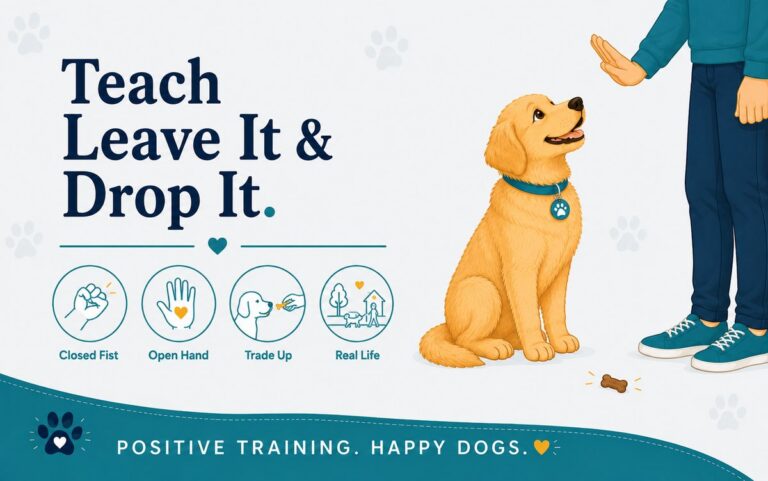
Place a treat in your closed fist and let your dog sniff and paw at it. Say “leave it” and simply wait. The moment your dog gives up and pulls back, even briefly, say “yes” and reward them with a different, better treat from your other hand. The lesson your dog learns is powerful: ignoring the thing you said to leave earns something even better. Practice with treats on the floor and eventually with items during walks.
6. Drop It
While Leave It means do not pick it up, Drop It means let go of what is already in your mouth. It is invaluable for retrieving something dangerous your dog has grabbed, and for stress-free games of fetch.
The kindest way to teach this is as a trade. When your dog has a toy, offer a tasty treat near their nose and say “drop it.” Most dogs will open their mouth to take the treat, dropping the toy. Reward, then often give the toy back so they learn that dropping does not mean losing their fun forever. Trading up to something good keeps your dog happy to give things up, rather than guarding them.
7. Heel or Walk Nicely
Walking politely on a leash makes daily walks a joy instead of a battle. While formal heel keeps your dog tucked right by your side, most owners simply want a dog who does not pull.
The core lesson is that pulling gets them nowhere. The moment the leash goes tight, stop walking and become a tree. When the leash loosens, praise and move on. Reward your dog generously for walking near your side. It feels slow at first, but your dog quickly learns that a loose leash keeps the walk going. This is one of the harder skills to truly master, so be patient and consistent, and expect it to develop over weeks rather than days.
8. Off
Off tells your dog to get down from furniture, or to stop jumping up on people. It is a manners essential, especially for bigger dogs or homes with visitors.
The key is to reward four paws on the floor and to avoid accidentally rewarding jumping. When your dog jumps up, turn away and ignore them completely, giving attention only when their paws are back on the ground. You can pair the calm, grounded moment with the word “off” and a reward. Consistency from everyone your dog meets is what makes this stick, since one person who lets the dog jump up undoes everyone else’s work. For a deeper dive on this behavior, see our full guide on how to stop your dog jumping up.
How to Put It All Together
Do not try to teach all eight commands at once. Pick one or two to focus on, get them fairly solid, then add the next. A sensible order is to start with sit, since it is the easiest win and builds your dog’s confidence in the whole training game, then move to come and stay for safety, and add the others as you go.
Practice woven into daily life works wonders. Ask for a sit before meals, a stay at the door, a leave it when something interesting appears on a walk. This kind of real-world practice cements the commands far better than isolated training sessions alone, because your dog learns to listen everywhere, not just during official training time. If you would like a structured way to sequence it all, our guide to building a dog training plan lays out how these pieces fit together over your first weeks.
Keeping the Commands Reliable
Teaching a command in your living room is only the beginning. Dogs do not automatically generalize, so a dog who nails sit at home may look at you blankly at the park. The fix is to practice each command gradually in more distracting places and to keep rewarding, even occasionally, long after your dog seems to know it. Adding clear hand signals alongside your spoken cues also makes commands more reliable and gives you a way to communicate at a distance or in noisy places.
The Bottom Line
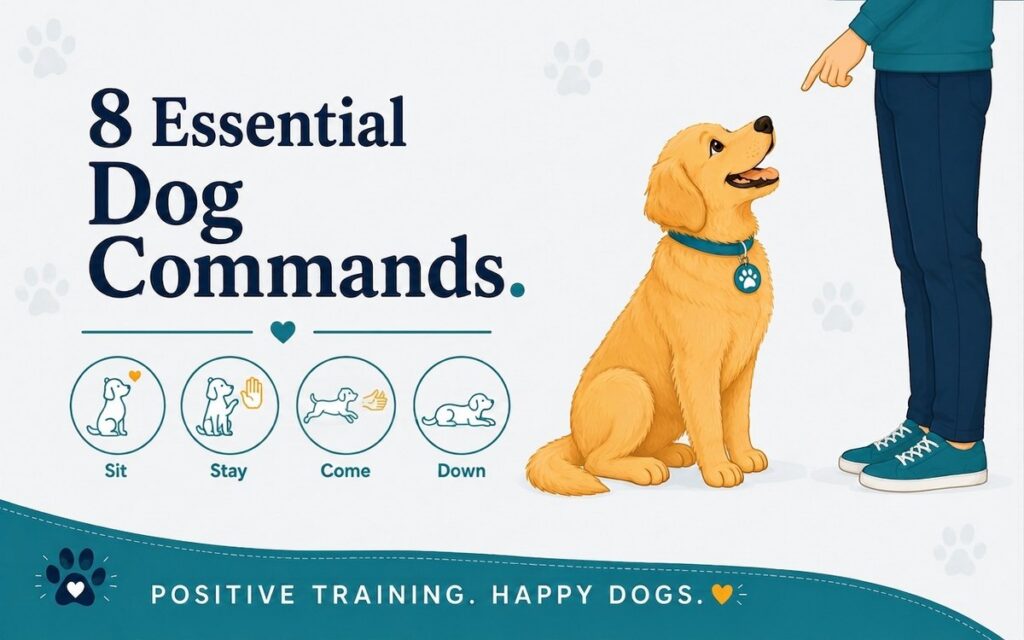
You do not need a huge repertoire to have a wonderfully well-behaved dog. Eight essential commands, sit, come, stay, down, leave it, drop it, walking nicely, and off, cover safety, manners, and everyday life. Teach them one at a time with short, positive sessions and plenty of rewards, practice them in real situations, and keep them sharp over time. Put in that steady effort and you will end up with the calm, confident, responsive dog every owner hopes for. Pick one command, grab your treats, and start today.