Affiliate Disclaimer: This post contains affiliate links. If you purchase through them, I may earn a small commission at no extra cost to you. I only recommend programs I genuinely believe can help you and your dog.
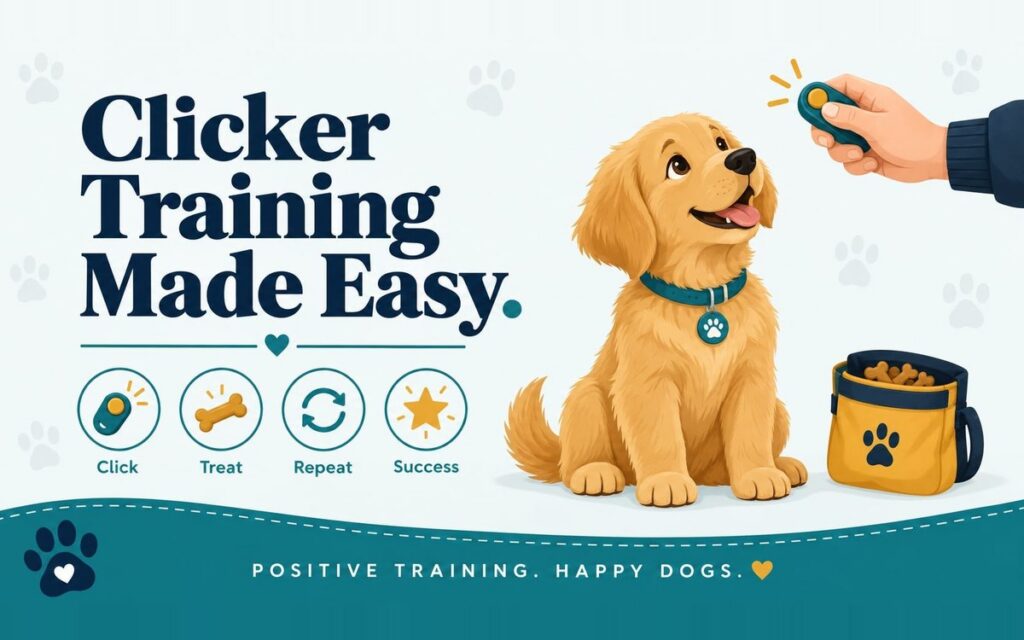
A clicker is a tiny plastic box that makes a sharp, consistent click. It costs almost nothing, fits in your pocket, and can make your puppy training noticeably faster and clearer. Many first-time owners are a little skeptical. How can a click help? The answer lies in timing, and once you see it working, it is hard to go back.
This guide explains how clicker training works, how to introduce the clicker to your puppy, and a set of first lessons to get you started. It also covers the most common mistakes, which are almost always about timing rather than the puppy.
How Clicker Training Works
Clicker training is a form of positive reinforcement that uses a marker signal. The click tells your puppy, with pinpoint precision, “that exact thing you just did is what earns the reward.” A treat follows every click.
Why is this better than just handing over a treat? Because there is always a delay between your puppy doing something and you getting a treat to their mouth. In that second or two, your puppy may have stood up, looked away, or sniffed the floor. Which one were you rewarding? The click bridges that gap. It captures the precise moment of success, so your puppy learns faster and with less confusion.
The click works because your puppy learns that it always predicts something good. That association is built in the very first step.
What You Need
- A clicker. Any basic box clicker works. Some have a softer click for noise-sensitive puppies.
- Tiny, tasty treats. Pea-sized and soft. My homemade puppy training treats are ideal.
- A treat pouch so rewards are always within reach.
- A quiet room for the first sessions.
No clicker? A short, sharp marker word like “yes” works on the same principle. The clicker simply sounds the same every time, which makes it a little clearer for your puppy.
Step 1: Charge the Clicker
Before the click means anything, your puppy has to learn that it predicts a treat. This is called charging the clicker, and it takes just a few minutes.
- Sit with your puppy in a quiet room with a handful of treats.
- Click once, then immediately give a treat. Your puppy does not need to do anything.
- Repeat ten to fifteen times, with a few seconds between each.
- Do two or three short sessions like this over a day.
You will know the clicker is charged when your puppy’s head whips toward you, looking for the treat, the instant they hear a click. If your puppy is startled by the sound, muffle it in your pocket or switch to a softer clicker or marker word.
Step 2: Your First Lesson, Name and Attention
Start with something easy so your puppy experiences quick success. Wait quietly. The moment your puppy looks at your face, click and treat. Repeat. Within a few minutes, most puppies start staring at you hopefully, which is exactly what you want. Add their name just before they look, and you are building strong name recognition too.
Step 3: Teaching Sit With a Clicker
- Hold a treat at your puppy’s nose and move it slowly up and back over their head.
- The moment their bottom touches the floor, click.
- Give the treat.
- Repeat five to ten times, then try with an empty hand making the same movement.
- Once your puppy sits reliably to the hand signal, say “sit” just before you move your hand.
The click lands exactly when the bottom hits the floor, not when your puppy stands up to take the treat. That precision is the whole point. If you want to use signals alongside words, my guide to dog training hand signals pairs nicely with clicker work.
Step 4: Teaching Down
- Ask for a sit.
- Lower a treat slowly from your puppy’s nose to the floor between their paws.
- Click the moment their elbows touch the ground.
- Treat on the floor between their paws to reinforce the position.
If your puppy pops up instead, lower the treat more slowly, or click for small steps toward the floor at first.
Step 5: Teaching Touch
Hand targeting is a brilliant early skill. It is easy to teach and becomes the building block for recall, loose leash walking, and moving your puppy around without pulling on their collar.
- Hold your flat palm a few centimeters from your puppy’s nose.
- Most puppies will sniff it. The moment their nose touches your hand, click and treat.
- Repeat, gradually moving your hand to different positions.
- Add the word “touch” once they are bopping your hand reliably.
Once your puppy loves this game, you can build it into fun tricks from my easy dog tricks list.
Capturing and Shaping
The clicker opens up two powerful techniques beyond luring.
Capturing
Capturing means clicking a behavior your puppy offers naturally. If your puppy lies down on their bed on their own, click and treat. If they settle quietly, click and treat. Over time, they offer these behaviors more often. Capturing is perfect for teaching calmness, which is one of the most valuable things a puppy can learn.
Shaping
Shaping means clicking small steps toward a final behavior. To teach your puppy to go to their bed, you might click for looking at the bed, then for stepping toward it, then for putting one paw on it, then for standing on it, then for lying down on it. Shaping takes patience, but puppies who learn this way become brilliant problem solvers.
Common Clicker Mistakes
Clicking Too Late
The most common mistake. If you click a second after the behavior, you are marking whatever happened next. Watch closely and click at the exact moment.
Clicking Without Treating
Every click must be followed by a reward, even if you clicked by accident. Breaking that promise weakens the meaning of the click.
Using the Clicker to Get Attention
The click is a marker, not a way to call your puppy. Use their name or a recall cue for that.
Holding Treats in Your Clicker Hand
Your puppy may start watching your hand instead of focusing on what they are doing. Keep treats in a pouch and reach in only after you click.
Sessions That Are Too Long
Three to five minutes is plenty. End while your puppy is still enjoying it.
Fading the Clicker
The clicker is a teaching tool, not something you need forever. Once a behavior is reliable and on a cue, you can stop clicking for it and switch to occasional verbal praise and rewards. Keep the clicker for teaching new skills or polishing tricky ones.
Fitting Clicker Training Into Your Plan
Clicker training works beautifully alongside every other part of raising a puppy, from house training to recall. If you want to know which skills to teach when, my puppy training schedule by age lays it out week by week, and the Puppy Training 101 guide covers the foundations. For a printable version to tick off as you go, grab the checklist.
Real-Life Ways to Use Your Clicker
Once your puppy understands the click, you can use it for far more than party tricks. Some of the most useful applications are the everyday ones.
Calm Greetings at the Door
Ask a family member to step outside and come back in. Click the instant all four of your puppy’s paws are on the floor, then toss the treat low so they stay down. Repeat this with lots of short entries and exits. Your puppy learns that keeping paws on the ground is what makes good things happen when people arrive, which pairs well with the ideas in my guide on how to stop dog jumping.
Handling and Grooming
Many puppies wriggle when you touch their paws, ears, or mouth. Touch a paw briefly, click, and treat. Gradually build up to holding the paw, then touching the nails with clippers, then trimming a single nail. The clicker lets you reward the precise moment your puppy stays relaxed, so vet visits and grooming become far less stressful for everyone.
Checking In on Walks
Bring the clicker on walks and click every time your puppy glances back at you on their own. These small check-ins are the foundation of loose leash walking and focus around distractions. You will soon have a puppy who looks to you before rushing toward the next interesting smell.
Settling in Busy Places
Sit at a quiet cafe table or a park bench and click for any calm behavior: lying down, watching people pass without pulling, or resting their chin on the ground. This is capturing in a real-world setting, and it builds a puppy who can relax anywhere.
Troubleshooting Clicker Training
My puppy is scared of the click
Some sensitive puppies flinch at the sound. Wrap the clicker in a sock, click it inside your pocket, or use a clicker with a volume button. You can also switch to a marker word for a while and reintroduce the clicker later at a distance.
My puppy gets overexcited and starts offering everything
This is actually a good sign. Your puppy has learned that offering behaviors pays. Calm things down by rewarding slower, more deliberate behaviors, and keep sessions very short. Ending with a simple sniff game or a chew helps an excitable puppy wind down.
My puppy only works when I have the clicker
That usually means the treats have become a bribe rather than a reward. Keep the treat pouch on during everyday life, not just training sessions, and start rewarding behaviors at random times. Over time, your puppy learns that good behavior can pay off at any moment.
I keep forgetting to click
Everyone does at first. Practice your timing without your puppy: bounce a ball and click every time it hits the floor, or click whenever a character on television blinks. It sounds silly, but a few minutes of this sharpens your reflexes fast.
Clicker Training FAQs
How old should my puppy be to start clicker training?
You can charge the clicker from the day your puppy comes home, usually around eight weeks. Young puppies learn quickly and enjoy the short, rewarding sessions.
Can I use a clicker with an older dog?
Absolutely. Dogs of any age can learn with a clicker. Older dogs who have been trained with corrections sometimes take a little longer to start offering behaviors, but most blossom once they realize that trying new things is safe and rewarding.
Do I need to carry the clicker forever?
No. Once a behavior is reliable on a cue, you can fade the click and use praise and occasional treats. Many owners keep a clicker in a coat pocket for teaching new skills.
Is a marker word as good as a clicker?
A marker word works well and is always with you. The clicker is slightly clearer because it sounds identical every time, while our voices change with mood. Many trainers use both: the clicker for teaching new skills and a marker word for everyday life.
What if multiple people in the house use the clicker?
That is fine, as long as everyone follows the same rules: click at the exact moment and always follow up with a treat. Consistency across the household helps your puppy learn faster.
Want a Step-by-Step Program?
If clicker training clicks for you, so to speak, you will probably enjoy Brain Training for Dogs by Adrienne Farricelli, a certified professional dog trainer (CPDT-KA). Its brain games use the same positive, marker-based principles to build focus and problem-solving skills, and each one comes with a video demonstration.
The Bottom Line
Clicker training gives your puppy crystal-clear feedback by marking the exact moment they get something right. Charge the clicker first, start with easy lessons like attention and sit, click at the precise moment, and always follow the click with a treat. Use capturing to reward calm behavior and shaping to teach more complex skills. With a little practice on your timing, you will find your puppy learns faster, enjoys training more, and starts offering good behavior all on their own.
Dog lover and devoted owner of a Golden Retriever named Poki, sharing what she has learned raising him with kind, positive methods. Learn more about Milica.