Every dog owner who has tried to teach a new command knows the quiet truth of training: the reward does most of the work. You can have perfect timing and endless patience, but if the treat in your hand does not excite your dog, you are fighting uphill the whole way. The right training treat turns a distracted, sniffing dog into one that locks eyes with you and waits for the next cue.
The problem is that the pet aisle is overwhelming. Dozens of bags, wildly different price points, and packaging that all promises the same things. So how do you actually pick a good store-bought training treat? This guide walks through what matters, what to ignore, and how to match the treat to the kind of training you are doing.
Why the Right Training Treat Matters So Much
Positive reinforcement works because your dog learns that a behavior leads to something good. The stronger the “something good,” the faster and more reliably the lesson sticks. Trainers talk about treat value on a scale, and understanding that scale changes how you shop.
Low-value treats are things your dog likes fine but will not work hard for, like a plain biscuit. High-value treats are the ones your dog would do almost anything for, usually soft, smelly, and meaty. Most training calls for something in the middle to high range, especially when you are working around distractions like other dogs, new places, or exciting smells.
A treat your dog shrugs at in the living room becomes completely useless at the park. That is why experienced owners keep a few different treats on hand and save the really good stuff for the really hard moments.
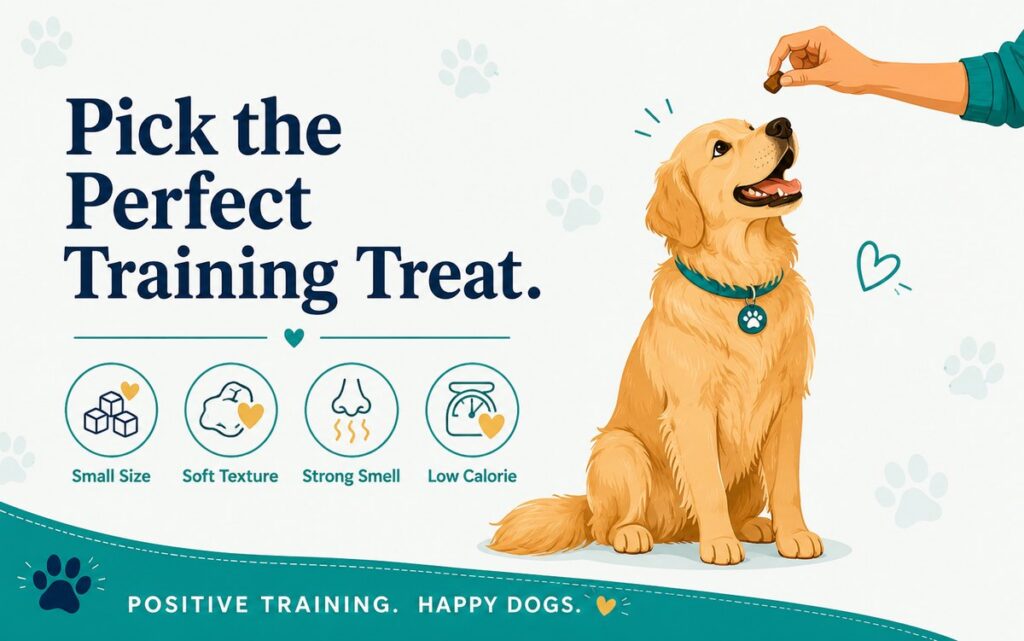
The Five Things That Actually Matter in a Training Treat
1. Size
This is the single most overlooked factor. A good training treat should be tiny, roughly the size of a pea or smaller. During a focused session you might reward your dog fifteen or twenty times in a few minutes, and if each treat is the size of a biscuit, you will fill your dog up and blow past a healthy calorie limit almost immediately.
Look for treats marketed specifically as “training treats” or “training bites,” which are usually made small on purpose. If a treat you love only comes in a larger size, you can always break it into pieces, though that gets messy and slows you down mid-session.
2. Softness
Soft, chewy treats beat hard, crunchy ones for training in almost every case. A dog can swallow a soft treat in a second and be ready for the next repetition, while a crunchy biscuit takes time to chew and scatters crumbs that break your dog’s focus as they hoover the floor. Save the crunchy stuff for casual rewards and keep soft treats for real training work.
3. Smell
Dogs experience the world through their nose, so a strong-smelling treat is a more motivating treat. This is exactly why liver, cheese, and fish-based options tend to work so well. If you can smell it clearly through the bag, your dog can smell it from across the yard, and that pulling power is what keeps their attention when the environment gets distracting.
4. Ingredients
You do not need a perfect, boutique ingredient list for a treat that makes up a small slice of your dog’s diet, but a few things are worth checking. Simpler is generally better. A short list where you recognize most of the words is a good sign. Some owners prefer to avoid added sugar, artificial colors, and certain preservatives, while others are fine with mainstream brands for the sake of price and availability. There is no single right answer here, only the choice that fits your priorities and your dog’s needs.
If your dog has a sensitive stomach or known allergies, limited-ingredient treats or single-protein options are worth the extra cost. A treat that gives your dog an upset stomach will derail training faster than anything.
5. Calories
Treats should make up no more than about ten percent of your dog’s daily calories. During heavy training that ten percent disappears fast, so lower-calorie training treats let you reward more often without overfeeding. Many brands now print calories per treat right on the bag, which makes this easy to track.
Matching the Treat to the Training
Not every moment calls for the same treat, and thinking in tiers will make your training far more effective.
For easy, familiar behaviors in a calm environment, like practicing “sit” in your kitchen, a basic low to mid-value treat is plenty. For newer or harder skills, or anywhere with distractions, reach for something higher value and meatier. And for the genuinely difficult situations, like teaching recall at a busy park or working with a nervous or reactive dog, bring out the highest-value treat you have. Your dog decides what counts as high value, so pay attention to what makes their eyes light up.
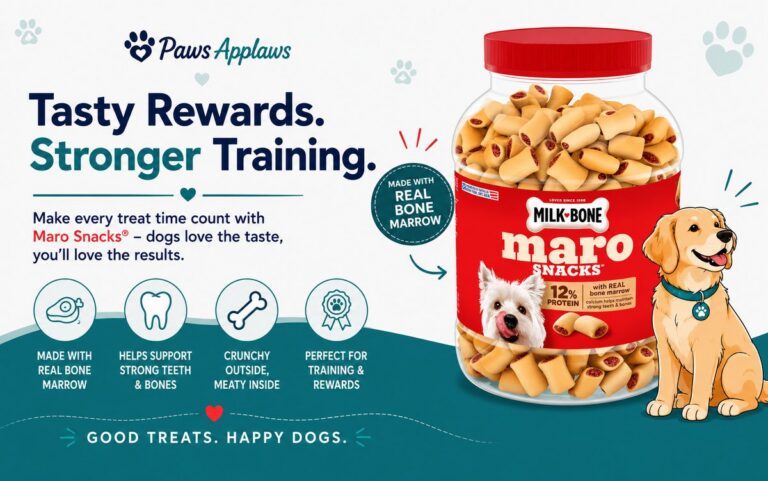
One popular option in the mid to high range is a treat built around real meat or marrow, which brings the aroma and taste dogs respond to while still being affordable and easy to find. If you want to see how one widely available example holds up for training specifically, we broke down the ingredients, size, and value in our honest review of Milk-Bone MaroSnacks, including where they shine and where they fall short.
Common Training Treat Mistakes to Avoid
Even good treats get used poorly. Here are the errors that quietly sabotage training sessions.
Using treats that are too big is the most common one, and it leads to a full, unmotivated dog within minutes. Using the same boring treat for everything is another, because your dog needs a reason to work harder in hard moments. Relying only on treats forever is a third mistake, since the goal is eventually to fade the food and reward with praise, play, and life rewards instead. And forgetting to account for treat calories can slowly lead to weight gain, which is why portioning matters.
One more subtle mistake: keeping treats visible before your dog performs. If your dog only obeys when they can see the food, the treat has become a bribe rather than a reward. Keep treats in a pouch or pocket, ask for the behavior first, then reward. That small shift teaches your dog to work for you, not just for the visible snack.
Do You Need Special Treats, or Will Human Food Work?
Plenty of everyday foods make excellent training rewards. Small pieces of plain cooked chicken, plain cheese, or certain dog-safe fruits and vegetables can be perfect. The tradeoff is convenience and mess. Store-bought training treats are designed to be dry enough for a pocket or pouch, pre-sized, and shelf-stable, which matters when you are training on the go or several times a day.
Many owners land on a mix: convenient bagged treats for daily sessions and quick outings, plus high-value human food like chicken for the toughest training challenges. There is no wrong answer as long as everything stays dog-safe and you keep the portions small.
The Bottom Line
The best store-bought training treat is small, soft, smelly, made with ingredients you are comfortable with, and low enough in calories to use often. Beyond that, the “best” treat is simply the one that motivates your particular dog, because motivation is the entire point. Buy a couple of different options, watch which one makes your dog light up, and build your training around that. If you are mapping out your training more broadly, it also helps to fit treats into a structured training plan so your sessions build on each other.
Get the treat right and everything downstream gets easier. Your timing matters more, your cues land faster, and your dog starts to see training as the best part of their day. That is exactly the foundation that positive, reward-based training is built on.