
Affiliate Disclosure: As an Amazon Associate, Paws Applaws earns from qualifying purchases. This post contains affiliate links, and we may earn a small commission if you buy through them — at no extra cost to you. We only feature products we believe are worth an honest look.
If you’ve ever tried to teach a dog anything, you already know the truth: the treat matters just as much as the technique. A reward your dog shrugs at won’t hold their attention past the first repetition, and a treat that’s too big or too crumbly turns a focused training session into a mess. That’s exactly the gap Milk-Bone MaroSnacks aim to fill — a bite-sized, high-motivation reward built around one attention-grabbing feature: real bone marrow.
In this review, we’ll take an honest look at Milk-Bone MaroSnacks Dog Treats with Real Bone Marrow (40 oz) through the lens that matters most to us here at Paws Applaws: positive, reward-based training. We’ll cover what they are, how they perform as a training treat, what’s actually in them, who they suit best, and — importantly — where they fall short. No hype, just a fair breakdown so you can decide if they belong in your treat pouch.
What Are Milk-Bone MaroSnacks?
First, a key distinction: MaroSnacks are a treat, not a complete dog food. They’re designed for rewarding, training, and occasional snacking — not for replacing meals. That’s an important framing, because a lot of the criticism these treats attract online comes from judging them by the standard of a daily food, which they were never meant to be.
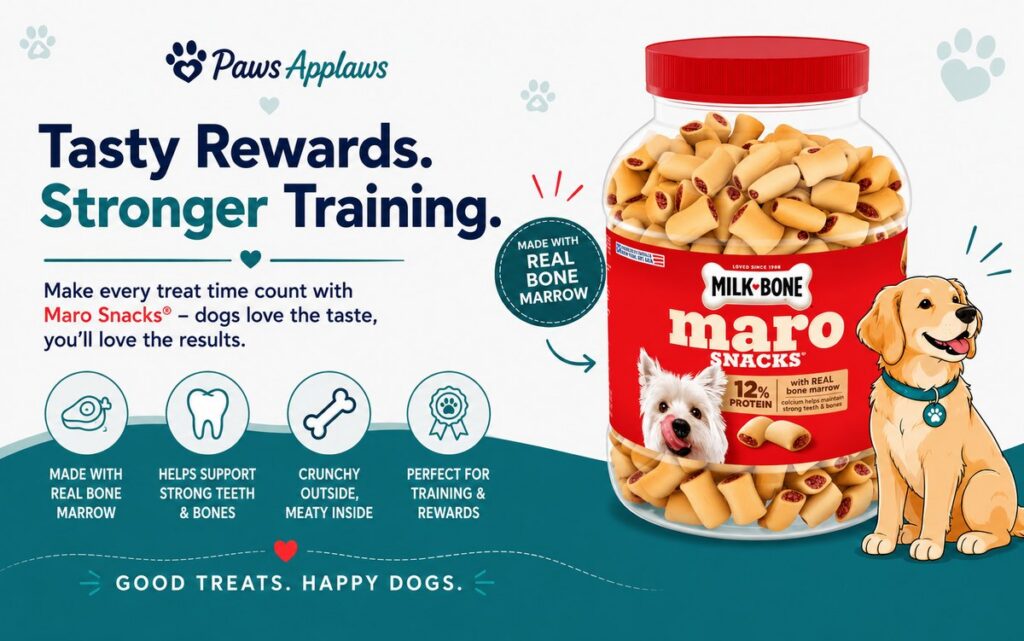
The signature feature is the texture. Each piece has a crunchy baked biscuit shell wrapped around a soft center made with real bone marrow. That two-in-one texture — crunchy outside, meaty inside — is the whole pitch, and it’s genuinely what sets them apart from a standard hard biscuit. Dogs get a satisfying crunch followed by a softer, more aromatic payoff, which tends to keep them interested.
Milk-Bone also highlights that the treats are made in Buffalo, New York, USA, and that they include added calcium to support strong teeth and bones. They come in a large 40 oz container, which is the version we’re focusing on here.
MaroSnacks as a Training Treat: The Part That Actually Matters
Since our whole focus at Paws Applaws is positive reinforcement, this is the section that counts most. A good training treat needs to tick a few boxes, so let’s run through them.
Motivation and Taste
The real bone marrow center gives these treats a strong aroma and a taste most dogs find genuinely exciting. In training terms, that matters: a treat has to be worth working for. High-value rewards are what get a dog to offer focus around distractions, and the meaty center pushes MaroSnacks toward the higher-value end of the mainstream-treat spectrum. For many dogs, they land somewhere between an everyday biscuit and a premium meat-based reward.
Treat Size
Here’s where honesty is important. MaroSnacks are bite-sized, but they’re built more for rewarding than for rapid-fire repetition training. For fast marker-based work — where you might deliver ten or fifteen rewards in a couple of minutes — whole MaroSnacks can be a touch large and a touch high in calories to use at that pace. The good news is they break apart reasonably well, so you can snap them into smaller pieces for small dogs or for high-frequency drills. If you train in quick bursts, plan to break them up.
Calorie Awareness
Because the center is rich, these are not a low-calorie treat. Milk-Bone’s own guidance is to feed roughly 1–2 treats per 20 lb (9 kg) of body weight, and — like all treats — to keep them to about 10% or less of your dog’s daily calorie intake. During an intensive training week, that 10% ceiling comes up faster than you’d expect, so breaking treats into smaller rewards isn’t just convenient, it’s the smart way to stay within a healthy limit.
What’s Actually Inside: Ingredients and Nutrition
An honest review has to look past the marketing and at the ingredient list. Here’s the reality.
Primary Ingredients
The main ingredients include: wheat flour, beef and bone meal, sugar, cooked bone marrow, beef fat, gelatin, natural flavor, calcium carbonate, oat fiber, and preservatives (BHA/BHT and sodium metabisulfite).
A few things stand out. Wheat flour is the first ingredient, which means these are firmly grain-based and not grain-free. There’s also added sugar, and the preservative system uses BHA/BHT and sodium metabisulfite. None of these are unusual for a mainstream, long-shelf-life biscuit treat — but if you specifically avoid wheat, added sugar, or artificial preservatives, this is where MaroSnacks will lose you, and you deserve to know that up front.
Guaranteed Analysis
The nutritional breakdown is straightforward for a treat:
- Protein: 12% minimum
- Fat: 7% minimum
- Fiber: 4% maximum
- Moisture: 12% maximum
- Calcium: 0.92% minimum
That’s a moderate protein level — appropriate for a reward rather than a primary food — with the added calcium the brand leans on for its “supports strong teeth and bones” messaging. The crunchy shell may also offer a small amount of mechanical plaque reduction during chewing, though you shouldn’t think of these as a dental treat in any serious sense.
Feeding Guidelines
For the large 40 oz version, Milk-Bone’s guidance is simple:
- Feed 1–2 treats per 20 lb (9 kg) of body weight.
- Keep treats to roughly 10% or less of your dog’s daily calories.
- Break treats into smaller pieces for small dogs (and for training).
- Always provide fresh water.
As with any treat, these numbers are a ceiling, not a target. If your dog is on the smaller side or watching their weight, err well below the maximum.
The Honest Pros and Cons
Here’s the balanced summary. We’ll start with what genuinely works.
What We Like
- The texture combination is a real differentiator — crunchy shell, soft marrow center. Dogs notice it.
- Strong motivation value thanks to the real bone marrow aroma and taste, which makes them effective as a reward.
- Added calcium for a modest teeth-and-bones benefit.
- Good value — the large 40 oz container delivers a lot of treats for the price.
- Widely available and well established — Milk-Bone has been around since 1908, and you can find these almost anywhere, which matters if you don’t want to reorder from an obscure brand.
What to Be Aware Of
- Wheat flour is the primary ingredient — a no-go if you’re avoiding grains.
- Contains added sugar, which many owners prefer to skip in a treat.
- Uses BHA/BHT and sodium metabisulfite as preservatives, rather than natural alternatives.
- Calorie-dense — you’ll want to break them up for training to stay within a healthy treat allowance.
- It’s a treat, not complete nutrition — obvious, but worth repeating given how much the branding emphasizes ingredients.
You’ll also find online reviews that criticize the ingredient list compared with premium or more natural treats. Those critiques are fair on their own terms, but they’re often comparing MaroSnacks to a different category of product. Anecdotal reviews — good or bad — should be read with a grain of salt; your own dog’s response is the real test.
Who Are MaroSnacks Best For?
MaroSnacks make the most sense for:
- Reward-based training and everyday positive reinforcement.
- Dogs who love a crunchy biscuit with a softer, meatier center.
- Owners who want an affordable, easy-to-find, long-established mainstream brand.
- Households that go through a lot of training treats and appreciate the bulk 40 oz value.
They’re a weaker fit if you’re specifically seeking limited-ingredient, grain-free, sugar-free, or naturally preserved treats. In that case, you’d be happier with a single-ingredient option — think freeze-dried liver, plain dehydrated meat, or a limited-ingredient training treat — even if it costs more per ounce.
How to Use MaroSnacks Effectively in Training
If you do add them to your training routine, a few practical tips will get the most out of them:
- Break them into pieces. Smaller rewards keep calories in check and let you deliver more repetitions per treat.
- Save them for higher-difficulty work. Because they’re higher-value, use them when you need extra motivation — around distractions, or when teaching something genuinely hard — and use plainer treats for easy reps.
- Mind the daily budget. Count treat calories as part of the 10% rule, and reduce meal portions slightly on heavy training days.
- Pair the treat with a marker. A clicker or a consistent “yes!” tells your dog exactly what earned the reward — the treat reinforces, but the marker teaches.
The Verdict
Milk-Bone MaroSnacks are a solid, honest middle-ground training treat: motivating enough to hold a dog’s attention, affordable in the large container, and easy to find anywhere. The real bone marrow center genuinely earns its place as a reward, and the texture is something dogs respond to.
They’re not a premium, clean-label product — the wheat-first ingredient list, added sugar, and artificial preservatives are the trade-off for that mainstream price and availability. If those things are dealbreakers for you, look at a limited-ingredient alternative. But if you want an effective, budget-friendly reward from a brand that’s been trusted for over a century, and you’re smart about portioning them for training, MaroSnacks are an easy treat to recommend a try.
As always, the treat is only half the equation. Pair it with consistent, positive, reward-based training and you’ll get far more mileage out of any snack in your pouch.
Prices and availability on Amazon are accurate as of the date of publishing and are subject to change. Always check the product label for the most current ingredient and feeding information.