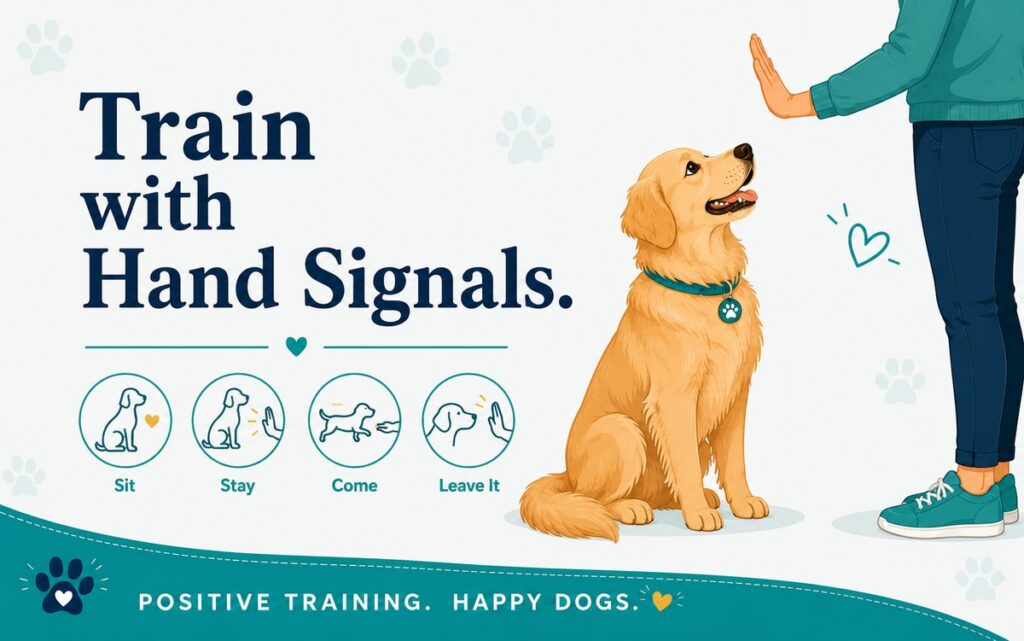
Most people teach their dog commands with words, and that works fine right up until the moment it does not. Your dog is across a noisy park and cannot hear you. You are on a phone call and cannot speak. Your dog is getting older and their hearing is fading. In all of these situations, a dog who understands hand signals still knows exactly what you are asking.
Here is something that surprises a lot of owners: dogs actually read our body language more naturally than they process our words. They are watching us constantly, picking up on the tiniest shifts in posture and movement. That makes hand signals not just a backup plan but often an easier and clearer way to communicate. This guide covers the most useful hand signals, how to teach them, and why they are worth adding to your training toolkit.
Why Hand Signals Are So Powerful
Dogs are visual communicators by nature. In a pack, so much of how they interact is through posture, movement, and subtle physical cues. When you use a clear hand signal, you are speaking a language your dog is wired to understand.
There are real practical benefits too. Hand signals work at a distance where your voice might not carry. They work in noisy environments like busy parks or homes full of kids. They are essential for dogs who are deaf or losing their hearing with age, and they give you a calm, quiet way to communicate that does not add tension to a situation. That quiet, low-tension communication can be especially useful when you are working with a reactive dog who is already on edge. Many trainers find that dogs respond faster and more reliably to a visual cue than a spoken one once both are learned.
A Few Principles Before You Start
Consistency is everything with hand signals. Pick one clear gesture for each command and use the exact same motion every single time. If your “sit” signal changes shape from day to day, your dog has to guess, and guessing slows learning. It also helps if everyone in the household uses the same signals, so your dog is not learning three different versions of “down.” Hand signals slot naturally into a wider dog training plan, usually once the spoken commands are already solid.
Make your signals distinct from one another so they are easy to tell apart, and make them big and clear at first. You can shrink them down to something subtle later once your dog knows them cold. Keep sessions short and upbeat, just a few minutes at a time, and always pair the signal with a reward when your dog gets it right.
The Essential Hand Signals Every Dog Should Know
Sit
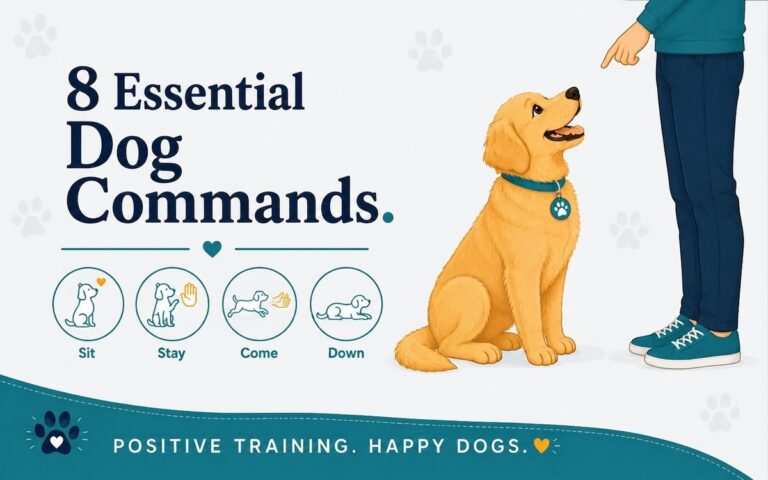
A common sit signal is a flat hand, palm up, moving upward from your side toward your shoulder. The upward motion naturally encourages your dog to lift their head and lower their back end into a sit. It is one of the easiest signals to teach because the movement itself guides the behavior.
Down
For down, many people use the opposite of sit: a flat hand, palm facing down, moving from up near your chest toward the floor. The downward sweep mirrors the behavior you want, which helps your dog connect the gesture to the action of lying down.
Stay
The classic stay signal is an open palm facing your dog, held up like a stop sign. It is intuitive for humans and clear for dogs. Present the palm, pause, and reward your dog for holding position, gradually building up the time and distance before you release them.
Come
A reliable recall signal is a big, welcoming motion, often a sweep of your arm from out to the side inward toward your chest. Because recall is a safety command, make this signal large and unmistakable so your dog can read it clearly from a distance.
Heel or Come to Your Side
Many owners use a pat on the side of their leg, or a hand held at the hip, to signal their dog to come into the heel position beside them. It is a natural gesture that points to exactly where you want your dog to be.
Leave It
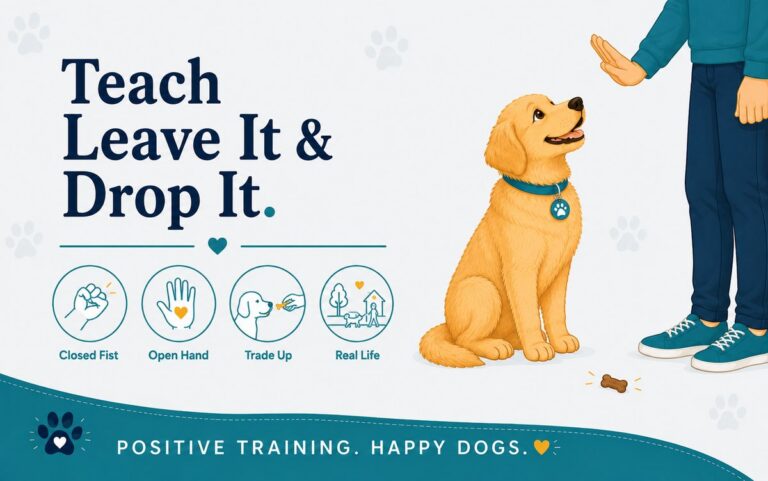
A closed fist, sometimes with a subtle downward motion, is a common “leave it” signal. It pairs naturally with the way the command is often first taught, using a closed hand to hide a treat until the dog stops trying to get it.
How to Teach a Hand Signal Step by Step
The easiest way to teach hand signals is to build on a command your dog already knows by voice. Here is the process.
Start by giving your new hand signal first, then immediately follow it with the spoken command your dog already understands. Your dog performs the behavior in response to the familiar word, and you reward. After many repetitions, your dog begins to connect the gesture with the action, because the gesture reliably predicts the word.
Now start testing. Give just the hand signal and pause for a couple of seconds. If your dog performs the behavior, celebrate and reward generously. If they look confused, no problem, simply follow with the spoken command as before and keep practicing. Over time you drop the spoken word entirely and the hand signal stands on its own.
If you are starting a signal completely from scratch with no existing verbal cue, you can lure the behavior with a treat in your signaling hand, then gradually fade the treat until the empty-hand motion becomes the signal itself.
Common Mistakes to Avoid
The most frequent error is accidentally using two different signals for the same command without realizing it. Film yourself training if you are not sure, because you may be adding little hand movements you are unaware of. Another common issue is making signals too similar, so your dog cannot tell “sit” from “down.” Keep them visually distinct.
Owners also tend to give up too soon, expecting a dog to read a silent signal after only a few tries. Give it time and keep pairing the signal with the known word until the connection is solid. And do not forget to reward the visual cue just as generously as you rewarded the spoken one when it was new. The signal is a fresh skill and deserves fresh reinforcement.
Taking Hand Signals Further
Once your dog has the basics, you can build a genuinely quiet, connected way of working together. You can shrink the signals down to small, subtle movements that look almost like mind-reading to anyone watching. You can string signals together for more complex sequences. And you will have a communication system that holds up when your voice cannot do the job.
For older dogs especially, teaching hand signals early is one of the kindest things you can do. If hearing loss comes later in life, a dog who already understands visual cues can keep communicating with you clearly and confidently, which protects their safety and their sense of security.
The Bottom Line
Hand signals tap into the way dogs naturally communicate, which makes them clearer, faster, and more reliable than many owners expect. Start with the essentials of sit, down, stay, and come, teach them by pairing each gesture with a command your dog already knows, and stay consistent. Within a few weeks of short, positive sessions, you will have a dog who understands you without a single word spoken, and that quiet connection is one of the most rewarding parts of training.