Your dog hears the doorbell, and before you can react they are up on their back legs, paws on your guest, tail going like a helicopter. Or you walk through the door after work and get bowled over by a wiggling, jumping bundle of joy. Jumping up is one of the most common dog behavior complaints, and one of the most frustrating, because your dog is not being bad. They are being thrilled to see someone.
That is the first thing to understand, and it changes how you fix it. Jumping is almost always about excitement and seeking attention, not dominance or disobedience. Once you know that, the solution becomes clear: teach your dog that keeping four paws on the floor is what earns the attention they crave, and that jumping makes attention disappear. Here is exactly how to stop your dog jumping, calmly and for good.
Why Dogs Jump Up in the First Place
Dogs greet each other face to face, so jumping up to reach our faces is a natural instinct. On top of that, jumping usually gets a big reaction from us, whether that is petting, talking, or even pushing them down. To a dog, any of that counts as attention, and attention is exactly what they wanted. So the behavior gets rewarded and repeats.
Here is the part most owners miss. Even negative reactions like saying “no,” pushing the dog off, or making eye contact while scolding can act as rewards, because your dog still got you to engage. This is why yelling at a jumping dog so rarely works and often makes it worse. The dog wanted your attention, and you gave it to them.
The Golden Rule: Attention Is the Reward
Every effective method for stopping jumping comes down to one principle. Attention is the reward your dog is working for, so you control the behavior by controlling the attention. Four paws on the floor makes good things happen. Jumping makes all attention vanish.
Consistency with this rule is everything. If your dog learns that jumping works even one time in ten, they will keep trying, because occasional rewards are powerful motivators. Everyone who interacts with your dog has to follow the same rule, or the mixed messages will stall your progress. Get the whole household and your regular visitors on board.
The Core Technique: Remove Attention
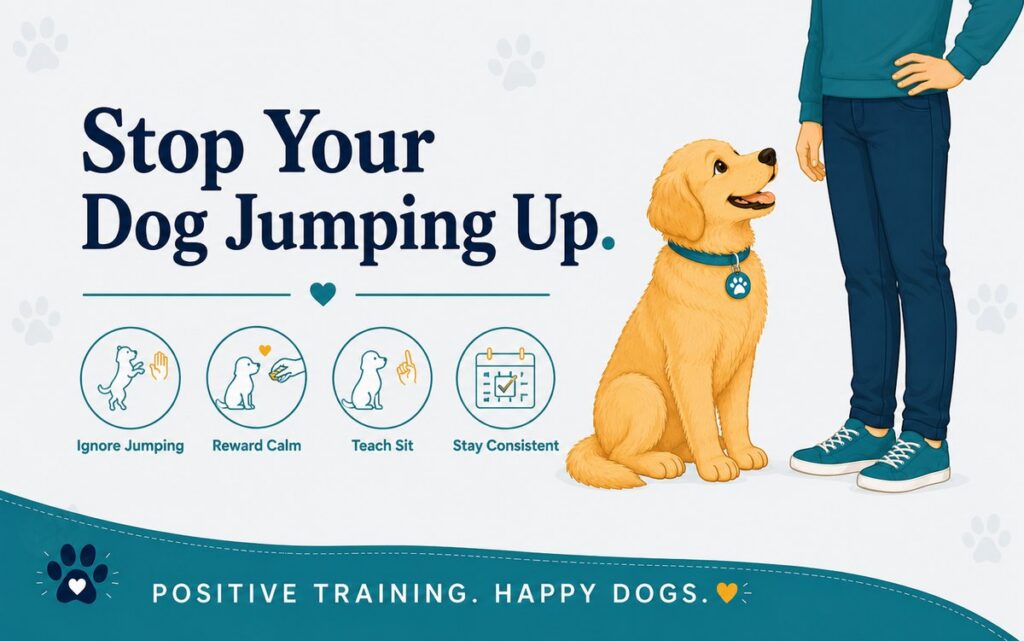
This is the foundation, and it is beautifully simple. The instant your dog jumps up, remove your attention completely. Turn your back, fold your arms, look away, and stay silent. No talking, no eye contact, no touching. Become as boring as a wall.
The moment your dog puts all four paws back on the floor, or better yet sits, immediately turn back and reward them with the calm attention they wanted. If they jump again, turn away again. Your dog quickly learns the pattern: jumping makes you disappear, calm brings you back. Timing matters here, so be ready to turn away the instant paws leave the floor and to reward the instant they land.
Stay calm and low-key through all of this. Big dramatic reactions, even turning away in an exaggerated huff, can read as exciting to your dog. Quiet and matter of fact works best.
Teach an Alternative Behavior
It is much easier for a dog to learn what to do than simply what not to do. So alongside removing attention for jumping, actively teach and reward a behavior that makes jumping impossible. Sitting is perfect, because a dog cannot sit and jump at the same time.
Practice asking for a sit during greetings and reward it heavily. Over time, your dog starts to offer a sit automatically when they want attention, because that is the behavior that has always paid off. Some owners like to teach a specific greeting spot, like a mat the dog goes to when someone arrives. Whatever you choose, the idea is the same: give your dog a clear, rewardable job to do instead of jumping.
Managing Greetings at the Door
The front door is where jumping is usually at its worst, because arrivals are the most exciting moment of your dog’s day. A little management makes training far easier while your dog learns.
Keep things calm as you come in rather than greeting your dog with high energy, since your excitement fuels theirs. Ignore your dog until they have settled, then greet them calmly once all four paws are down. For visitors, it helps to have your dog on a leash or behind a baby gate at first, so they physically cannot jump on guests and rehearse the unwanted behavior. Ask guests to ignore the dog until they are calm, then reward the calm. It can feel awkward asking visitors to play along, but it is the single fastest way to fix door jumping.
What Not to Do
A few common reactions backfire, so it is worth naming them. Do not knee your dog in the chest, step on their back paws, or grab their legs. These old-fashioned punishments can hurt or frighten your dog, damage your relationship, and often do not even work, since the dog may see the physical contact as engagement. Do not shout, since that is attention too. And do not be inconsistent, because letting your dog jump up sometimes, perhaps when you are in scruffy clothes and do not mind, teaches them that jumping is sometimes worth a try. Kind, consistent, and calm always beats forceful.
Be Patient and Consistent
Jumping is a deeply practiced habit for many dogs, so it will not vanish overnight. You may even see it briefly get worse before it gets better, as your dog tries harder at the behavior that used to work. This is normal, and it is actually a sign the method is taking effect. Hold steady, keep the whole household consistent, and reward calm greetings generously.
Remember too that a dog with plenty of exercise and mental stimulation has an easier time containing their excitement in the first place. If your dog is bursting with pent-up energy, some of that spills out as jumping, so meeting their daily needs makes the training work better. Our list of dog enrichment ideas can help take the edge off that excess energy.
The Bottom Line
Your dog jumps because they are excited and want your attention, so the fix is to make calm behavior the thing that earns attention and jumping the thing that makes it disappear. Turn away when they jump, reward the moment four paws are down, teach a sit as a greeting, and manage exciting moments like the front door while your dog learns. Skip the old forceful tricks, stay consistent across everyone your dog meets, and be patient through the process. Do that, and those over-the-top jumping greetings turn into a polite, happy sit before you know it.