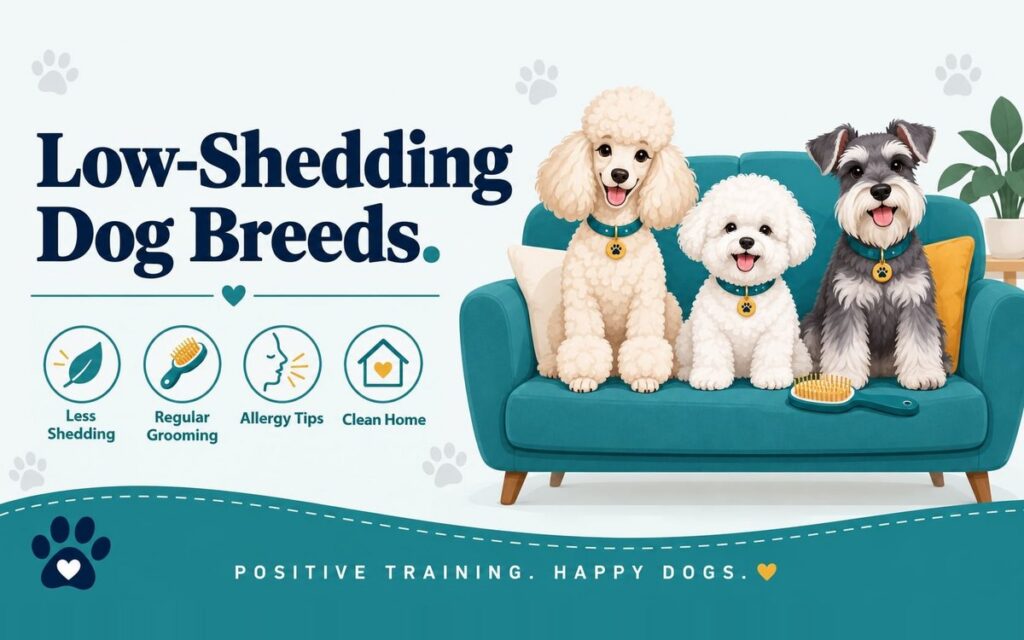
If you love dogs but sneeze every time you stroke one, or simply dread the idea of hair on every surface, a low-shedding breed might be the answer. Many people with mild dog allergies live happily with breeds whose coats shed very little, and plenty of people choose them just to keep their homes tidier.
Before we get to the list, there is one important thing to understand, because it saves a lot of disappointment later.
The Truth About “Hypoallergenic” Dogs
No dog breed is completely allergy-free. Dog allergies are mainly triggered by proteins found in skin flakes (dander), saliva, and urine, not by the hair itself. Every dog produces these proteins.
So why do low-shedding breeds help some people? Their coats tend to trap dander and hair rather than releasing it all over your home. Less hair on the floor and furniture can mean fewer allergens floating around. Some people with allergies react much less to these breeds, but others still react, and individual dogs within the same breed can vary.
The best advice is to spend time with the specific breed, ideally the specific dog, before you commit. Talk to your doctor if your allergies are severe.
15 Low-Shedding Dog Breeds
1. Poodle (Toy, Miniature, and Standard)
Poodles are the classic low-shedding breed, with tight curls that trap loose hair. They come in three sizes, so there is a Poodle for almost every home. They are highly intelligent and trainable, but need regular professional grooming and plenty of mental stimulation.
2. Bichon Frise
Cheerful and affectionate, Bichons have a soft, curly white coat that sheds very little. They need regular brushing and grooming to prevent matting. They are great with families and enjoy company.
3. Maltese
The Maltese has a long, silky white coat of hair rather than fur, which sheds very little. Many owners keep it trimmed short for easier care. Gentle and playful, they suit calmer homes.
4. Shih Tzu
Affectionate and relaxed, Shih Tzus have a long, flowing coat that sheds minimally but tangles easily. Regular brushing or a short puppy clip keeps them comfortable. They adapt well to apartment life.
5. Yorkshire Terrier
Yorkies have fine, silky hair that is quite similar in texture to human hair. They shed little, but the coat needs regular care. Small, brave, and lively, they suit owners who enjoy a feisty personality.
6. Havanese
The Havanese has a soft, silky coat that sheds little and a sociable, adaptable personality to match. They are great with families and happy in apartments, though their coat needs frequent brushing.
7. Portuguese Water Dog
Athletic and water-loving, Portuguese Water Dogs have a dense, curly or wavy coat that sheds very little. They are energetic working dogs who need plenty of exercise and enjoy active families.
8. Miniature Schnauzer
With a wiry coat that sheds little, Miniature Schnauzers are alert, intelligent, and fun. Their coat needs regular grooming to keep its shape. The Standard and Giant Schnauzers share the same low-shedding coat in bigger sizes.
9. Soft Coated Wheaten Terrier
Wheatens have a silky, wavy, wheat-colored coat that sheds very little. They are friendly, playful, and often great with families, with a bouncy terrier personality. Regular brushing prevents matting.
10. Bedlington Terrier
Often said to look like a little lamb, Bedlingtons have a soft, curly coat that sheds minimally. They are gentle and affectionate at home but can be lively and fast outdoors.
11. Lagotto Romagnolo
This Italian breed, traditionally used to hunt truffles, has a dense, curly coat that sheds little. Lagottos are intelligent, affectionate, and keen workers who need mental and physical exercise.
12. Coton de Tulear
The Coton has a soft, cotton-like coat that sheds very little. Cheerful, gentle, and devoted, they make lovely companions and adapt well to most homes.
13. Chinese Crested
Available in a hairless variety, with hair only on the head, tail, and feet, and a “powderpuff” variety with a soft full coat, Chinese Cresteds shed very little. The hairless type needs skin care, including sun protection.
14. Basenji
Basenjis have a short, fine coat that sheds little, and they groom themselves almost like cats. Known as the barkless dog, they make unusual yodeling sounds instead. They are independent and energetic, suiting experienced owners.
15. Afghan Hound
With their glamorous, flowing coat, Afghan Hounds shed relatively little, but that coat needs a lot of grooming. Dignified, independent, and fast, they suit owners with time for regular coat care.
What About Doodles?
Crossbreeds like Goldendoodles, Labradoodles, and Cavapoos are often marketed as non-shedding. Some are, but many are not, because a puppy can inherit a coat from either parent. If low shedding is essential for you, meet the parents, ask the breeder about coat types in previous litters, and spend time with the puppy before deciding.
Low Shedding Usually Means More Grooming
This is the trade-off many people do not expect. Coats that do not shed keep growing and trap loose hair, which means they mat easily. Most low-shedding breeds need:
- Brushing several times a week, sometimes daily
- Professional grooming every four to eight weeks
- Regular checks for mats behind ears, under legs, and around the collar
Start gentle handling and brushing when your dog is a puppy, pairing it with treats, so grooming becomes a pleasant routine rather than a battle.
Living With a Dog When You Have Allergies
- Keep the bedroom dog-free to give yourself an allergen-reduced space.
- Use a HEPA air purifier and vacuum with a HEPA filter regularly.
- Wash dog bedding weekly in hot water.
- Choose hard floors and washable covers where possible.
- Wash your hands after handling your dog.
- Bathe your dog regularly with a gentle dog shampoo, as advised by your vet or groomer.
- Talk to your doctor about allergy management options.
Choosing the Right Low-Shedding Breed
Low-shedding breeds vary enormously in size and energy. A Maltese and a Portuguese Water Dog both shed little, but they need very different lifestyles. Think about how much exercise and grooming you can manage, and whether you have children. For more guidance, see the best small dog breeds, the best family dog breeds, and calm dog breeds.
Training Your Low-Shedding Puppy
Many low-shedding breeds, like Poodles and Schnauzers, are very bright and love to learn, while some smaller ones can be slower to house train. Whatever you choose, kind and consistent training from day one makes all the difference. Puppy Training 101 covers the foundations, the small breed puppy training guide has tips for Shih Tzus and Yorkies, and my printable checklist keeps you on track week by week.
How to Test Your Allergies Before You Commit
Reading about a breed tells you very little about how your own body will react to it. The only reliable test is time spent with real dogs, and the more of it the better. A quick five-minute cuddle at a show is rarely enough, because allergy symptoms often build slowly over several hours.
- Visit more than once. Spend a couple of hours with the breed on two or three separate occasions, ideally indoors where allergens collect.
- Meet adult dogs, not only puppies. A puppy coat often changes as the dog matures, and adult coats can produce a different reaction.
- Bring every allergic family member. One person may be fine while another reacts strongly, so test everyone who will live with the dog.
- Ask about a trial period. Some rescues offer foster-to-adopt arrangements, which let you live with a specific dog for a week or two before deciding.
- Notice delayed symptoms. Itchy eyes, a stuffy nose, or tight breathing that shows up the evening after a visit still counts.
Taking the time here protects you and the dog. Rescues see too many low-shedding dogs handed back because a family member reacted after a few weeks, and that is heartbreaking for everyone involved.
The Real Cost of a Low-Shedding Coat
Low-shedding breeds save you money on lint rollers and vacuum bags, but grooming more than makes up for it. Most of these coats need a professional trim every four to eight weeks, and prices vary widely depending on your area, your dog’s size, and how well the coat has been maintained at home. A large Standard Poodle or Portuguese Water Dog will cost considerably more per visit than a Maltese.
You can keep costs down by doing more yourself. A good slicker brush, a metal comb, and a detangling spray go a long way, and some owners learn to do simple clips at home with quiet clippers. The biggest saving comes from never letting the coat mat. A matted dog often has to be shaved right down, which is uncomfortable for them and usually means a longer, pricier appointment.
Budget time, too. A few minutes of brushing most days is easier than an hour-long battle once a week, and it gives you a chance to check skin, ears, and paws as you go.
Health Screening to Ask About
A low-shedding coat says nothing about a dog’s overall health, so look beyond the coat when you choose a breeder. Responsible breeders health-test their breeding dogs for the conditions common in their breed and are happy to show you the results. A few examples worth asking about:
- Poodles: hip scoring for Standards, eye testing, and screening for certain inherited conditions depending on size.
- Bichon Frise and Maltese: knee (patella) checks and eye examinations.
- Miniature Schnauzer: eye testing, plus a conversation about diet, since the breed can be prone to pancreatitis.
- Portuguese Water Dog and Lagotto Romagnolo: hip scoring and breed-specific DNA tests.
- Soft Coated Wheaten Terrier: screening relevant to kidney and digestive conditions seen in the breed.
Your national kennel club or breed club usually publishes the recommended health tests for each breed. If a breeder is vague or dismissive when you ask, keep looking.
Questions to Ask a Breeder or Rescue
- Can I meet the mother, and ideally the father, in their home environment?
- What health tests have the parents had, and can I see the certificates?
- Have any of your puppy buyers had allergy problems, and how did it go?
- What coat types have previous litters had, especially for crossbreeds?
- How have the puppies been socialized so far, and are they used to being brushed and handled?
- Will you take the dog back at any age if things do not work out?
For a rescue dog, ask how the dog behaves during grooming, whether they have lived with children or other pets, and whether any previous owners mentioned allergies. Good rescues answer openly because they want the match to last.
Frequently Asked Questions
Do low-shedding dogs need baths more often?
Many benefit from a bath every few weeks, which also helps reduce dander in your home. Use a gentle dog shampoo and ask your groomer or vet what suits your dog’s skin, since over-bathing can dry it out.
Are small low-shedding breeds better for allergies than big ones?
Size can help a little, simply because a smaller dog produces less dander and saliva overall. Coat type and the individual dog matter more, so a large Standard Poodle may suit you better than a small breed you happen to react to.
Will my puppy’s coat change as they grow?
Yes, often. Many low-shedding breeds go through a coat change somewhere between six and eighteen months, when the soft puppy coat gives way to the adult one. Matting can be worse during this stage, so brush more often until it settles.
Can I build up a tolerance to my own dog?
Some people find their symptoms ease over time with one familiar dog, while others find they get worse. It is not something to rely on, so make your decision based on how you react now and speak to your doctor about your options.
Is a low-shedding breed easier to train?
Coat type has nothing to do with trainability. Poodles and Schnauzers are known for being quick learners, while some toy breeds take longer to house train. Every breed learns best with patient, reward-based methods, and my essential dog training commands guide is a great place to start.
The Bottom Line
Low-shedding breeds like Poodles, Bichons, Maltese, Shih Tzus, Havanese, and Schnauzers can make life with a dog much more comfortable for many people with allergies, and much tidier for everyone. Just remember that no breed is completely allergy-free, low-shedding coats need regular grooming, and individual dogs vary. Spend time with the breed first, plan for grooming, and use a few simple household habits to keep allergens down. With the right choice, you can enjoy all the love a dog brings without the constant sneezing.
Dog lover and devoted owner of a Golden Retriever named Poki, sharing what she has learned raising him with kind, positive methods. Learn more about Milica.